


A NEW AIR PURIFICATION PLANT MODEL.
our Team
SHU
is an Egyptian team of 3 girls in grade 10 trying to be problem solvers of their community whose names are Omnia, Julia, and Aghaby.
every one of us had hope hade a dream passion a creative ides to see a better future as everyone's hope so we collaborated to get our best
We are here to develop for the best we hope to solve a part of the coronavirus problem so that we can coexist with it as much as possible under these difficult circumstances so we intensified our efforts and gathered our ideas using the International Space Station and NASA Information Agency.
since what happened In December 2019 in which a huge pandemic appears all over the world and this pandemic has spread in a rapid way around the world. This pandemic is called COVID-19.
However, NASA decided to solve the challenges that face the world because of COVID-19 .from this challenge is purifying the air like Air pollution that refers to the release of pollutants into the air that is detrimental to human health and the planet as a whole. Air pollution in the form of carbon dioxide and methane raises the earth’s temperature and effects on human health, so we decided to help the world to solve a part of this problem.
So keep watching us and see how shu is going to solve this problem with a cost-effective project that can help the community.

The mechanism or idea of theoperation of the developed plant
Welcome to this development journey. We have intensified our efforts to work with the best and most practical structure and materials available for the project of the present and the future. Here we are working to solve the problem of the present and benefit in the future. NASA to amend and add our own touch to their amazing efforts, get excited to smoke inside the formation of our device, so it consists of three stages and we put these stages below a development plant to help us with the last step in our system. The first stage is a fan hood that works with the battery and it is small enough to purify the air of a room to draw The right quantities of air and enter it to pass on the second stage, which are several very thin walls of minerals that are coated with tiny holes coated with tio2, which represents titanium dioxide as an effective photocatalyst for the destruction of volatile organic compounds (VOC), NOx and SO2 in indoor and outdoor air. The mechanism for removing the selected pollutants as well as the rate of reaction depends on some of the main influencing factors. And the light gets to complete this mission by penetrating the light of the pregnant bearer of this system and two things come out of this process, they are carbon dioxide and water vapor which takes us to the third stage where the silica gel that absorbs this moisture and takes out the carbon dioxide for the plant. Of the many viruses and invisible things accompanying the air.

First of all, this idea is inspired by the international space station, where they use the plants in food in oxygen production. Also, they use silica gel to reduce the humidity of the air.
Our project is a developed plant which is chosen according to the high-quality standards of NASA in plants purifying the air. It is not just a plant but the plant is a part of the project. The plant pot contains other important components. First, the pot is separated into two isolated parts. the first part is the upper part which contains the plant. The second part is the lower part. Which is separated by a small wall that contains a hole to allow the air passage. The first stage contains small extractor fans that suck the air, layers of metal wire cloth painted with titanium dioxide which will purify the air from nitrogen oxides, volatile organic compounds (VOCs), and carbon monoxide (CO). therefore water and carbon dioxide will be produced as by-products. Next, In the second stage, silica gel will absorb the water to reduce the humidity and let the air pass. then the plant will purify the air from carbon dioxide the other gases like Trichloroethylene, Formaldehyde, Benzene, Xylene, Ammonia, Sulphur Dioxide (SO2), and the Suspended Particulate Matter. Finally, we hope that this project can make a change and contribute to the reduction of air pollution.

We've got to pause and ask ourselves: How much clean air do we need? -Lee Iacocca-. One of the most important problems facing the whole world is air pollution. Air pollution is a global mission that every problem solver should try to solve. Air pollution causes about 780,000 premature deaths per year in Africa. First thing first, indoor air pollution is one of the most dangerous pollutions facing us especially after the stay-at-home and shelter-in-place policies worldwide due to the COVID 19 crisis.
Moreover, according to the Environmental Protection Agency, the common residential indoor pollutants include excessive moisture, volatile organic compounds (VOCs), combustion products, radon, pesticides, dust particles, viruses, and bacteria.
In December 2019 a huge pandemic appears all over the world and this pandemic has spread in a rapid way around the world. This pandemic is called COVID-19. definitely you heard about it.
Coronavirus disease (COVID-19) is an infectious disease caused by a newly discovered coronavirus. At this time, there are no specific vaccines or treatments for COVID-19. However, there are many ongoing clinical trials evaluating potential treatments. there are nearly 360000 deaths worldwide because of COVID19 and there are nearly 6000000 people worldwide are infected with COVID-19 .this huge number of infections return to that COVID-19 virus spreads primarily through droplets of saliva or discharge from the nose when an infected person coughs or sneezes, so this make the virus sustain on any surface for hours with the other viruses. these other viruses can make the human immune system very weak so this will lead to a big chance for the COVID19 infection.
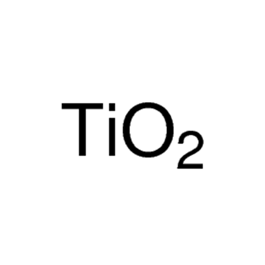
Titanium dioxide (TiO2) photocatalysis is one of the main components of this project. It is a catalyst that can do it during the presence of ultraviolet rays (almost from the sun). when the UV rays on titanium dioxide, it loses electrons that react with water molecules that present in the air forming (OH-)) and various odors, viruses, and stains that come near the titanium dioxide decompose to become harmless. TiO2 can get rid of some harmful gases like nitrogen oxides (NOx), volatile organic compounds (VOCs), carbon monoxide (CO), and ozone and convert them into more environmental byproducts like water and carbon dioxide. Also, NASA used it in the development of Airocide which is a good air purifier that can destroy airborne bacteria, mold, fungi, mycotoxins, viruses, volatile organic compounds, and odors. Therefore, titanium dioxide is a good solution for air purification
NASA plants
National Aeronautics and Space Administration (NASA) in collaboration with Associated Landscape Contractors of America (ALCA) carried out Clean Air Study and published results that provide a definitive list of plants that are most effective at purifying indoor air.
found that plants are effective at filtering likes of benzene, ammonia, and formaldehyde, etc from the air, helping to neutralize the effects of Sick building syndrome. They found certain tropical plants, which are commonly used as houseplants, are quite effective in removing formaldehyde, trichloroethane, benzene and other pollutants from the air and replacing them with breathable oxygen.
From the common indoor pollutants are Trichloroethylene, Formaldehyde, Benzene, Xylene, Ammonia, Nitrogen Dioxide (NO2), Sulphur Dioxide (SO2), and the Suspended Particulate Matter. There are some plants recommended by NASA that can purify the air from these indoor pollutants. Some of these plants are BOSTON FERN, PEACE LILY, ENGLISH IVY, MONEY PLANT, SNAKE PLANT, and many other plants.

Silica gel, a highly porous, nanocrystalline form of silica used to remove moisture from gases and liquids.
It is generally prepared by acidification of a solution of a silicate, such as water glass; the resulting silicic acid forms either a rigid mass or a gelatinous precipitate from which soluble materials are removed by washing with water. The water is finally removed by heating, leaving a glassy, granular solid. For the highest activity as a desiccant, the gel is not completely dehydrated but is left with a small percentage of combined water.
as in our project, The TiO2 can get rid of some harmful gases like nitrogen oxides (NOx), volatile organic compounds (VOCs), carbon monoxide (CO), and ozone and convert them into more environmental byproducts like water and carbon dioxide so the Silica gel adsorbs and holds water vapor from the filtered air after removing the harmful gases from it to release water without humidity